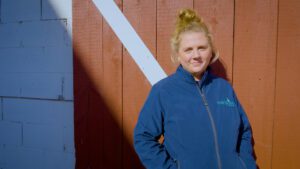

“Part of being a farmer is you’ve got to know lots of things.” James Harley speaks from experience. He and his family don’t just raise lamb, beef, pork, and chicken on their property near Keene, Ontario — they do it to the highest animal welfare standards while running a successful retail and wholesale operation. Along with his wife Jessica, parents Roger and Julie, and sister Emily, James and family take an approach to farming that emphasizes interconnectedness and stewardship.
Case in point, in 2014 Harley Farms became the first farm in Ontario to be certified by the SPCA. They’ve also earned top marks from the Animal Welfare Approved and Global Animal Partnership auditing programs, so consumers can place a high degree of trust in the Harley’s ethical standards. Their lamb and beef are 100% grass-fed, and while their pork and chicken receive some grain, the Harleys run their own feed mill so they can guarantee it’s all non-GMO. “We don’t eat breakfast until every single animal on this farm has been checked,” Emily adds, in her thick West Country accent.

The Harleys emigrated from the UK in 2000 and found the territory near Keene surprisingly familiar. The gently rolling hills are less than ideal for cash crops, but perfectly suited to animal husbandry. “Basically, the big draw for us in this area is that it’s great livestock country,” says James. “Hills and valleys and things are great for livestock. They can get into shelter, perfect country for raising livestock outdoors.” The Harley’s picturesque farm has even provided the backdrop for two Subaru Forester ads looking to evoke a quintessentially rural feel.
The family has also taken care to harmonize the property with their livestock for best results. “Along with it being a healthier meat, the most important thing that I find everyone forgets when they’re trying to produce grass-fed is at the end of the day it’s got to taste good,” James says. “We grow the right crops for the livestock to eat. We don’t use livestock that are being bred to grow on corn, we use old-fashioned livestock that can produce on grass. We’re thinking about the breeds that we’re using, the methods we’re using, and the forages we’re growing for the livestock so we still end up with a good end product for the consumer.”


If the Harleys have a frustration, it’s lax labelling standards that allow lower grades of meat to be sold in the same category. “The problem with meat is, as soon as it’s in a package to the untrained eye it all looks the same,” says James. “With lamb you can definitely taste if you’ve got an older lamb. A lamb that’s not being fed on grass you’ll notice it – you can see it in the fat. Get a good quality cut, that’s the starting point.”
Key points to look for are marbling and the colour of the fat, which provide clues as to how an animal was raised. “You’ll see some grass-fed with no fat at all, which is somebody who’s produced something but not really put much effort into it – they’ve just put it out in the field and expect it to be grass-fed. You’ll [want to] see marbling, but not as much as corn-fed. Grass-fed fat isn’t nearly as yellow, it stays more white,” says James. “Another important thing to keep it tender is on a grass-fed animal you don’t want it nearly as big. If you use an animal that’s not as large your muscle fibres are a lot shorter, which keeps it more tender. It makes for a better eating experience.”

Despite their range of third-party certifications, the Harleys invite consumers to visit and confirm for themselves. “We want people go out there and actually see that what we do is what we say we do,” Emily says. “When we go out on a farm tour we see the sheep out in the fields, the cows out in the fields, and the pigs. You can actually see how they live walking and eating the grass and living how an animal should live.” After taking a tour, customers can bring home a few cuts from the on-site retail store. You might consider timing a visit to coincide with a seasonal special event — this winter the Harleys opened up a two-kilometre cross-country skating trail, and the public Lambing Event in April will include the opportunity to bottle-feed a baby lamb. For those without the luxury of time to visit, Harley Farms products are available through their online store. They can also be found at grocery and butcher shops throughout Toronto and Ottawa, as well as in nearby Peterborough at Jo Anne’s Place Health Foods.
With so much to take care of, you might think the Harleys would get run down. Instead they seem energized by the work. “That’s the thing with our family, we really can’t sit still for any period of time,” James says. “Sitting inside isn’t something that sits too well with us.” When you visit their thriving farm and taste their lamb chops, it shows.
This article is part of a series on our local producers and Feast ON certified restaurants who are hosting the 2019 Terroir Rural Retreat, an event that reconnects speakers, sponsors & media from the annual Terroir Symposium with the people and places that make Ontario’s food scene worth celebrating. Click here to discover how you can plan your taste-of-place trip with inspiration from this remarkable event and our unique & talented communities of producers.