
Photo credit: Cameron Curran
Head north from the village of Kirkfield and a striking change comes over the landscape. The treeline moves back towards the horizon and you’re surrounded on both sides by tall grasses and wildflowers. Slabs of limestone break from the soil like giant flagstones, and birds flit from the fenceline to hardy clusters of juniper. You’ve arrived in Carden Alvar, a rare form of grassland habit home to a range of uniquely adapted species.
It’s not hard to see the landscape is atypical, but pinpointing what makes it special takes a careful eye. Birding enthusiasts have long been drawn to the area, hoping to catch a glimpse of one of over 230 species such as the elusive loggerhead shrike or upland sandpiper. “Carden’s a very popular place,” says Neil Gray, president of the non-profit land trust Couchiching Conservancy. “We go out there probably at least once a week, and I can’t believe the number of people we’re getting there now from all over Ontario.”
Gray’s organization has worked hard to protect and document the Carden Alvar—Gray calls it the “bread and butter” of the approximately 15,000 acres the Couchiching Conservancy helps steward in partnership with other conservation groups. The Conservancy’s mandate is to acquire and care for properties of environmental significance, and Carden Alvar’s significance is undisputable. “The alvar itself is a limestone bedrock with a minimal amount of soil on it. It’s quite unique—in Ontario there’s only three areas that you would have an alvar,” Gray explains. “Napanee, Tobermory area, then you have our area, and our area is the largest of the three. If you put that in perspective to the world, there’s one alvar area, a very small one, in Ireland, two in England and about three in the Norway, Sweden area. Not a huge amount of land!”
Officially designated an Important Bird and Biodiversity Area, Carden is unique even among its fellow alvars. “For example, when we were out there on Wiley Road about two weeks ago we saw a couple of moose,” Gray says. “You wouldn’t see that in the UK! And the birds are different. There are some plant species that would be the same families, but the actual species themselves would be different.”
-

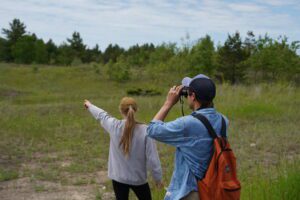
Tanya Clark walks at Carden Alvar (Toby Roland photo) -

Left: Kildeer Right: Upland Sandpiper (photo Neil Gray)


That means the area is of interest to naturalists of all stripes. Wildflowers, butterflies, dragonflies, and more are all found in abundance. “There’s up to nineteen species of orchids,” Gray adds. “Lady slipper is a very common one, but there’s lady trusses, which are smaller ones. They’re about half an inch in scale, compared to the lady slippers which are the showy ones. They can be 3 or 4 inches across. That’s what the beauty is of the alvar. Because of the limestone we have unique botanicals… There’s something there for everybody that’s into natural history.”
Learning about that natural history means gaining an admiration for the tenacity and hardiness of the alvar species. The shallowness of the soil means its ability to drain or retain water and to provide insulation from temperature extremes is limited. Flooding, drought, and hot and cold swings come with the territory, and survival under those conditions calls for distinctive adaptations. For example, the “hemiparasitic” flower painted cup survives by tapping the roots of nearby grasses; the aforementioned loggerhead shrike hunts by impaling its prey on the thorns of nearby bushes.
Couchiching Conservancy doesn’t shoulder the task of protecting that diversity all by itself. Funding, administrative responsibilities, and boots-on-the-ground maintenance duties are shared by a network of conservation interests that includes the Nature Conservancy of Canada, Ontario Parks, Ontario Field Ornithologists, Toronto Ornithological Club, and the Carden Field Naturalists, not to mention a small army of volunteers. To protect Carden Alvar’s health for the long term, the collective worked with local landowners and the provincial government to establish public access points and best practices. Their efforts resulted in the establishment of Carden Alvar Provincial Park in 2014, which covers a large swath of the Important Bird and Biodiversity Area. Though designated as “non-operating,” meaning it has no on-site site facilities or staff, the status ensures the ecosystem is protected. “We try to work with everybody to try to get ahead in this,” Gray says. “We work with a lot of the nature groups in the area as well. We had a group from the Kawartha Field Naturalists. They did a big flora survey. They actually found a number of species of plants that ended up in the herbarium in the ROM in Toronto because they’re just so unusual.”
Regardless of how the particulars are handled, the end goal is the same: to create continuous stretches of green space that allow wildlife to thrive. “We’re trying to create these biological corridors for the birds, animals, amphibians and reptiles, a lot of species that require non-fragmented land,” Gray says. “So much of the land has been fragmented by industry, human development, of course. All necessary things—but it’s just a matter of trying to find the balance so everything can get along.”
One of the methods Couchiching Conservancy uses to monitor that balance is the Citizen Science program. Around 300 volunteers receive training and equipment to monitor ecological factors such as water quality, reptile population, and vernal pond health. The data is then shared with related environmental organizations, and helps inform science-based decision-making. Gray says there’s still lots to learn, pointing to a recent experience with a visiting entomologist. “We did what we call a bio-blitz on the Cameron Ranch and the Windmill [alvar properties]. He was on Cameron and his expertise is butterflies. He found four species of butterfly that he never knew existed in that area.”
If you’d like to a do a little citizen science of your own—or just go for a beautiful hike—Couchiching Conservancy publishes a pamphlet on publicly accessible trails. Each trail shows different aspects of the alvar. Cameron Ranch, for example, is a classic “big sky” plain, while the Sedge Wren Marsh Trail winds through pockets of coniferous woodland. The North Bear Alvar, not shown on the map, is also open to visitors yet feels exceptionally quiet and remote. All you’ll need is decent footwear to guard against wet patches and possible ticks, water to keep yourself hydrated in sunny areas, and the good sense to avoid patches of poison ivy.
All of the trails reward an attentive, unhurried walk. Sometimes the eye roves freely across vast tracts of land; other times the focus narrows to tiny wildflowers stubbornly thriving in cracks in the limestone. Exploring Carden Alvar it’s hard not to be struck by the subtle, ingenious ways life adapts to its environment. While you’re marveling, spare a thought for the hardworking conservationists who’ve preserved it for generations to come.
-

Scarlet painted cup (photo Neil Gray) -
Aphrodite fritillary butterfly (photo Neil Gray)


Read more about conservation efforts in Kawarthas Northumberland in our feature articles, “Preserving the Kawarthas for Generations: Kawartha Land Trust“ and “Return of the Tallgrass Prairie: Exploring Hazel Bird Nature Reserve”