
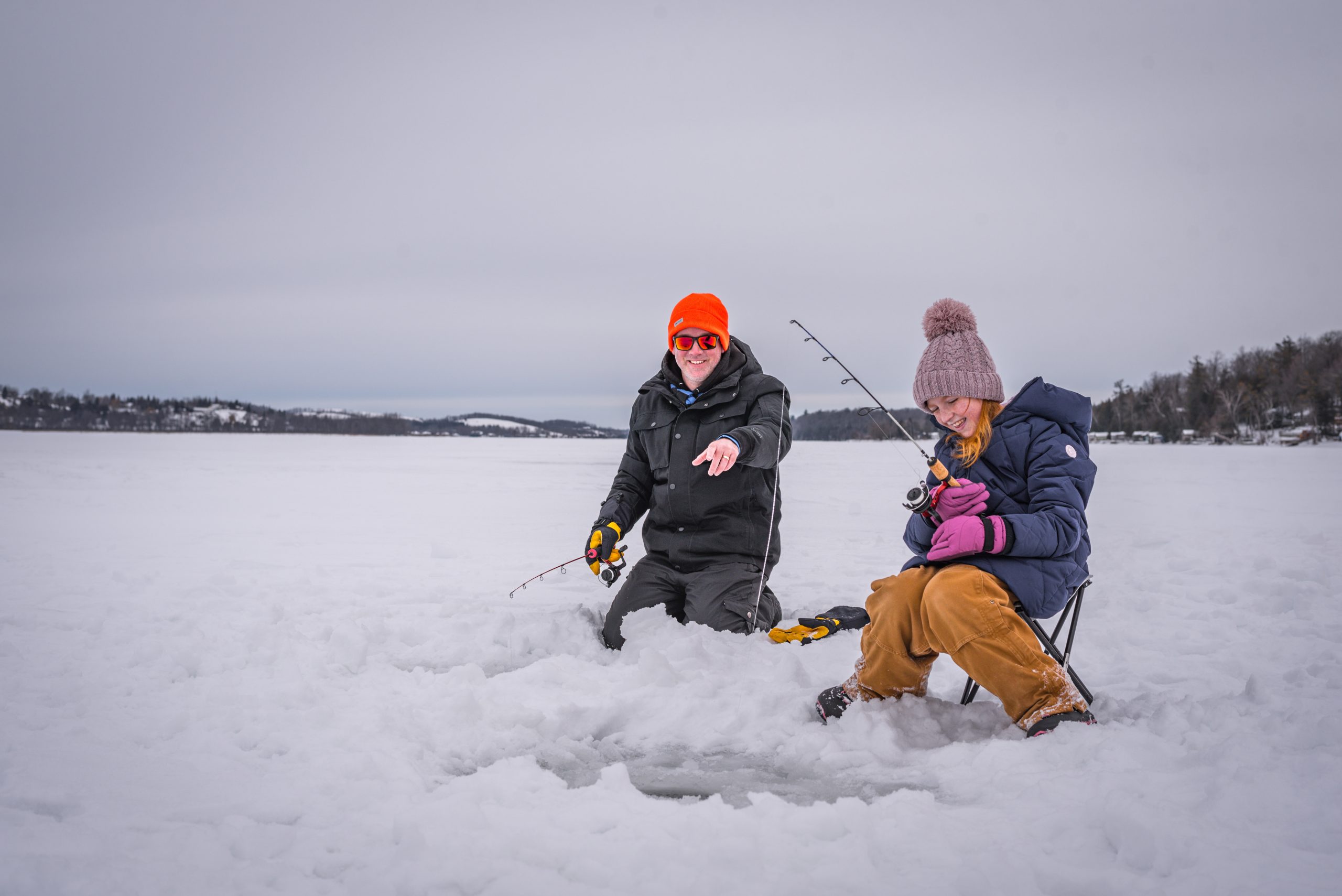
It’s one of the most iconic sights of Ontario winter—colourful ice fishing huts popping up across a frozen lake.
The huts may be a familiar part of the landscape, but not everyone’s had a chance to actually get out on the ice. In a region as rich with opportunities as Kawarthas Northumberland, there’s no reason for anglers not to give ice fishing a try. So we reached out to Adam Weir, a fisheries biologist with the Ontario Federation of Anglers and Hunters (OFAH), to find out how beginners might get started this season.
Who Is Ice Fishing For?
To begin with, Adam stressed the sport has broad appeal.
“I guess like any sort of outdoor activity, it varies from one person to the next in terms of what’s appealing,” he says. “Some like to catch lots of fish, and they’re looking at numbers. Others are seeking out memorable or trophy-size fish. Others are looking at it more from an angle of consumption and filling the freezer, and others prefer catch and release angling.”
It also attracts fans of all ages, and Adam says he’s looking forward to the day he can introduce his daughter to the joys of ice fishing.
How Do I Get Started?
Adam suggests setting modest expectations for your first time on the ice. “It’s probably important to set the bar relatively low for a first outing. Like anything, it’s about taking time and getting proficient,” he says. “If you have a friend that has experience ice fishing, connect with them, ask lots of questions, or even better yet, accompany them on an outing to learn the ropes.”
That avenue won’t be available to everyone, so Adam adds that online videos can go a long way towards demystifying the process. YouTube is a reliable source of how-to videos, and OFAH’s in-house content is tailor-made to keep anglers informed.
“We have OFAH Stream, and it provides all sorts of different videos and content, from beginner to advanced information. We have our TackleShare program too, which has lots of different introductory videos and online tips and help for newcomers to ice fishing. Be sure to check that out if you are a beginner. And then if you’re really enthusiastic and willing to spend the money, you could connect with a local guide.”
Especially if you decide to forgo a guide, instructional videos can give you a foundation to work from—and Adam recommends getting familiarized with safety tips first and foremost.
Safety First
There’s one crucial point newcomers and experts alike have to bear in mind: ice is inherently dangerous. Bibs and a jacket with built-in floatation are a smart way to mitigate the risk, and a part of Adam’s personal safety kit. He recommends ice picks and a spud bar for checking ice thickness as useful safety tools as well.
“As a general rule of caution, if the ice isn’t safe, don’t go out. If you check ice in one area and it’s safe, that doesn’t mean that the ice is necessarily safe in others, particularly where there’s flow or groundwater upwellings, anything like that. You need to be extremely careful.”
Exact ice thickness recommendations by weight can be found online, he adds. Do your research and know what type of ice to look for. Clear, blue-tinted ice is best, and ice with honeycomb patterning should be avoided.
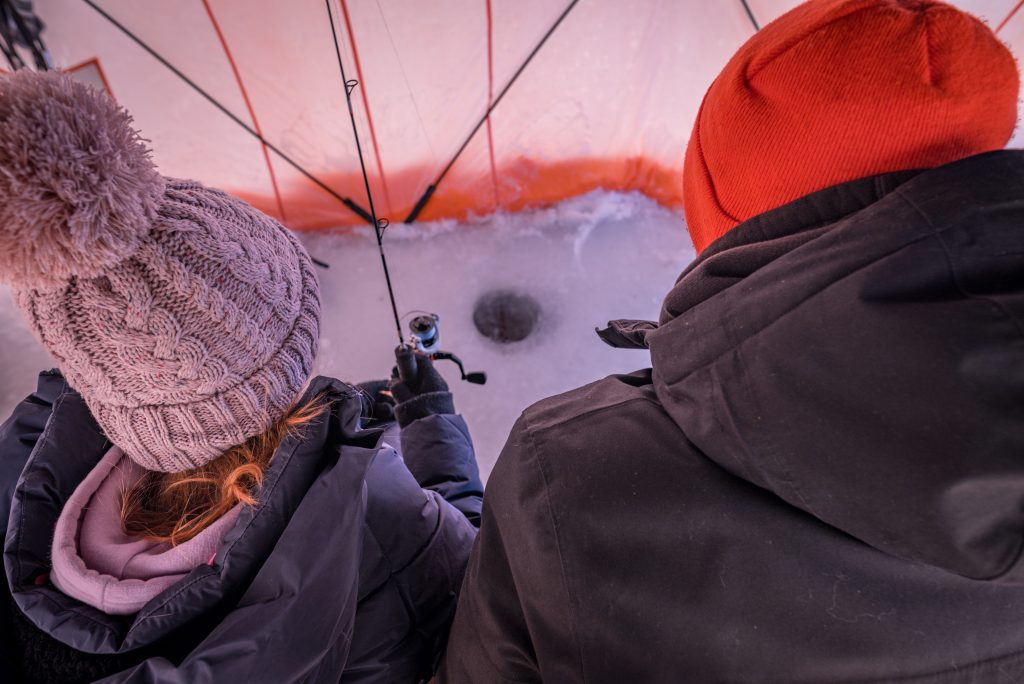
What Gear Do I Need?
You probably guessed this next part was coming—like warm-weather angling, gear options abound.
“Like any sort of sport, you can do a deep dive and really get into the weeds and nerd out on gear, ranging from not very expensive to extremely expensive,” Adam says. “If I was to point out some of the essential items that that I bring on a typical ice fishing trip, it would be some standard fishing gear with some additional items.”
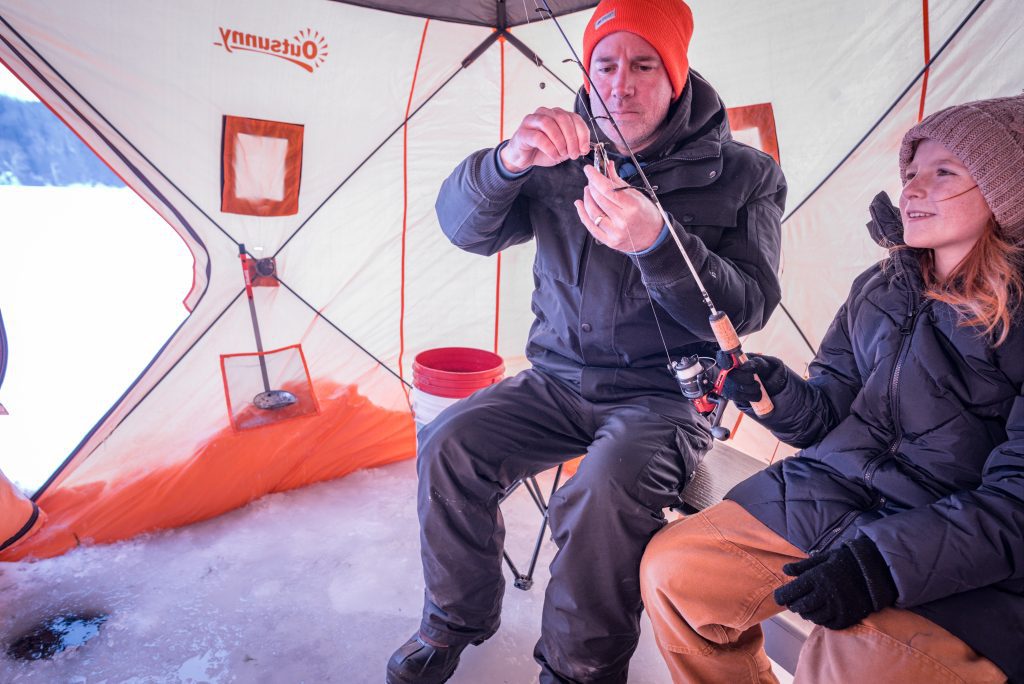
That list includes an ice fishing rod and reel combo, as well as lures, line, scissors, pliers, tackle box. In terms of specialized gear, Adam says tip ups, devices that suspend bait at a pre-set level, and jaw jackers, which automatically set hooks, can both be very helpful. Outside of the fishing gear itself, you’ll need to set up your site.
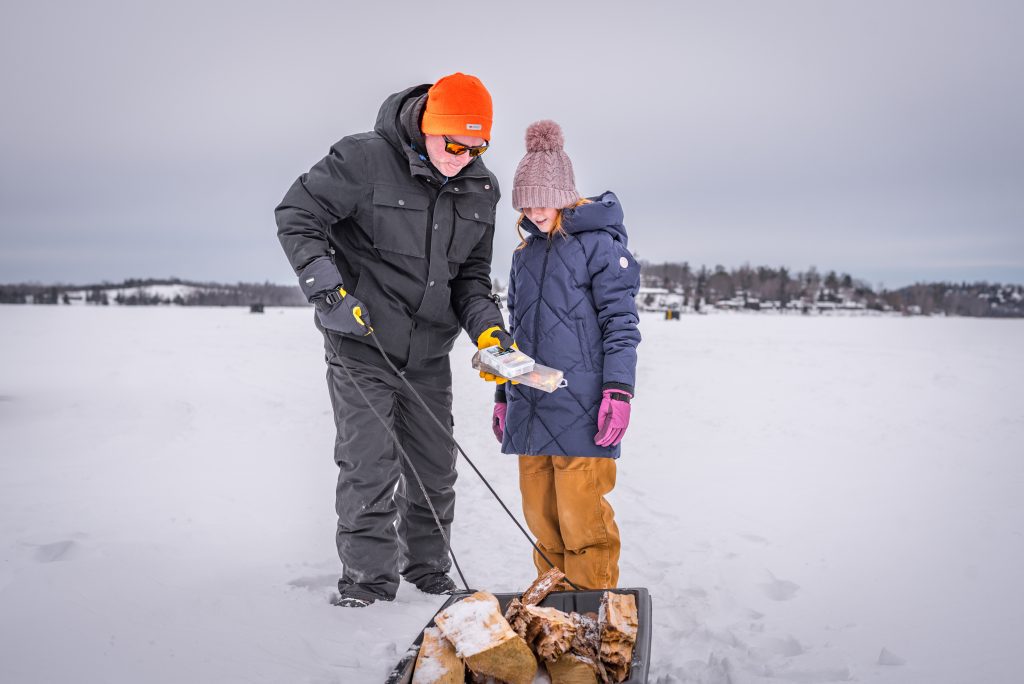
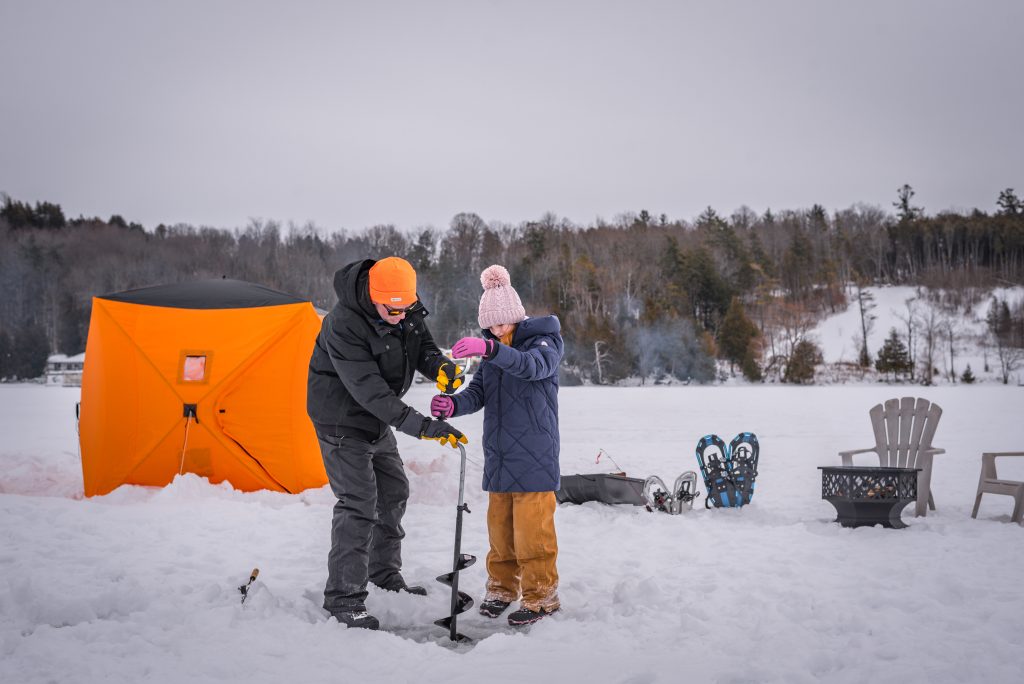
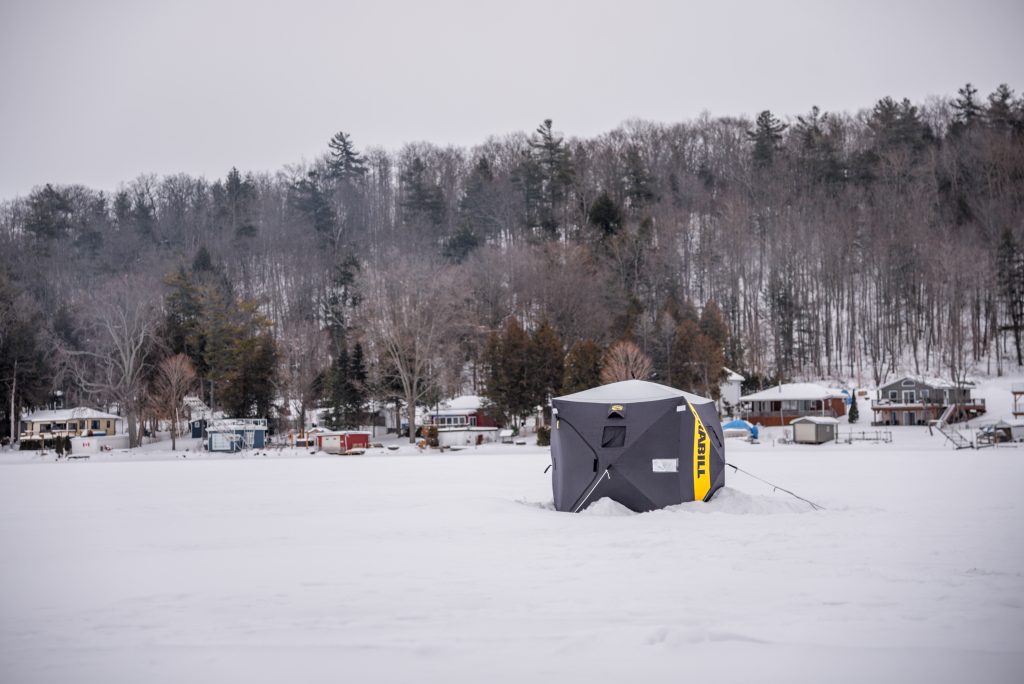
“I have a portable ice hut. They are relatively inexpensive too—big box stores like Canadian Tire and Costco sometimes sell ice huts. A seat is a definite requirement. Don’t forget a seat! An augur as well, obviously, and then an ice scoop is helpful too. I typically bring a sled just to pack all my gear in—it makes it easier for moving around and lugging all your equipment.”
Last but not least come the items for your personal warmth and comfort. “Always bring snacks, food, drinks. A hot beverage is always helpful. I usually bring a green tea, and then layering in warm clothes for the day. Especially if you’re auguring a lot of holes you’ll actually work up a sweat, and so having the layered clothing is really helpful to cool off if you do get a little overheated.”
If acquiring all that gear sounds daunting, Adam highly recommends the TackleShare program, which offers a gear lending library in addition to tutorial videos.

Where Can I Go Ice Fishing?
Bear in mind regulations dictate where you can and can’t fish, and it’s important to familiarize yourself with Ontario’s guidelines here. Within those limits, however, Adam says finding the right spot is a case of “choose your own adventure.”
“One of the easiest ways, even as a beginner, is the Ministry of Natural Resources Fish ON-Line GIS application. That’s a really critical, awesome tool that the Ministry puts out for the public to use. You can search different water bodies, and the species within those water bodies. It includes stocking information, monitoring data on some lakes, regulations, access points and a whole host of other information.
“At a desktop level, sitting at home or on your phone, you can actually do a whole lot of research that helps narrow down the different water bodies that you might want to fish within the Peterborough County, Northumberland, Kawartha Lakes region. All of that information is available there—don’t hesitate to lean into and use that online tool.”
What Will I Catch?
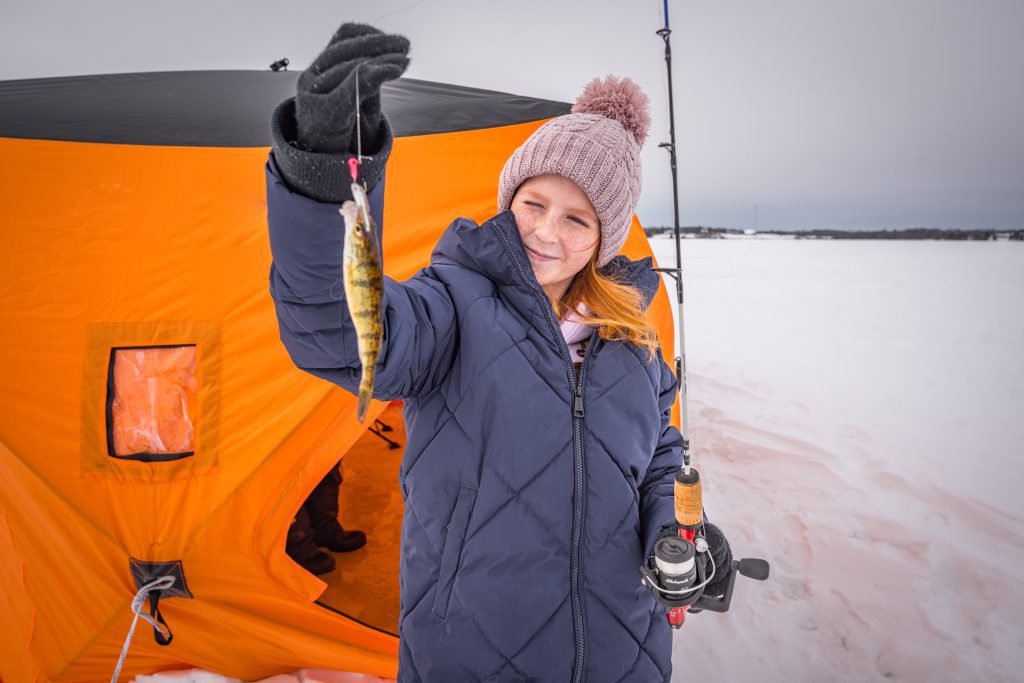
Fish ON-Line may give you a start choosing where to go, but once you arrive, the exact approach varies based on what you’re fishing for. The concept of “thermal guilds” determines where certain species are likely to be found.
“Thermal guilds would be like temperature preferences for fish,” Adam says. “We have warm-water, cool-water, and then cold-water species. So warm-water species, that goes for various types of panfish, say like bluegill or black crappie. If you were thinking of cool water species, that intermediate thermal regime, you would look at, say, yellow perch, walleye, pike opportunities.
“Cold-water species tend to be a favorite for winter angling. There’s lake trout and brook trout, lake trout being one of my favorite. For cold-water species, burbot is becoming a lot more popular too, also known as poor man’s lobster on account of them tasting really delicious.”
When Should I Go?
If you time your trip with an OFAH Family Fishing event, you can fish without the need to purchase a license. Note all other regulations and catch limits still apply.
Family Fishing Weekend runs from February 14 to 16 in 2026, but these events aren’t limited to just ice fishing. “There’s a Mother’s Day weekend, Father’s Day weekend, and the family fishing week later on, in the summer from June 27 to July 5,” Adam says.
He adds the OFAH is responsible for a range of other programming too, and their publication Ontario Out of Doors is a good way to stay connected. “You become a member and then you can subscribe and get our magazine. It gets distributed to 80+ thousand homes across Ontario, and it’s a great way to just tap into learning how to fish and hunt, and all sorts of different outdoor activities.
“We also have the Mario Cortellucci Hunting and Fishing Heritage Centre that’s right beside our main office [in Peterborough] and has kids’ day camps and a fishing pond, museum, aquarium, auditorium—it’s basically like this big education center. So feel free to stop by.”
Why Should I Go Ice Fishing?
“I’d like to point out that 100% of license sales goes back into conservation,” Adam says. “So it pays for things like monitoring, research, enforcement and all sorts of other things, including like stocking, for example.”
That’s one reason to feel good about an ice fishing trip, but on a more personal level, there are some significant mental and physical benefits as well.
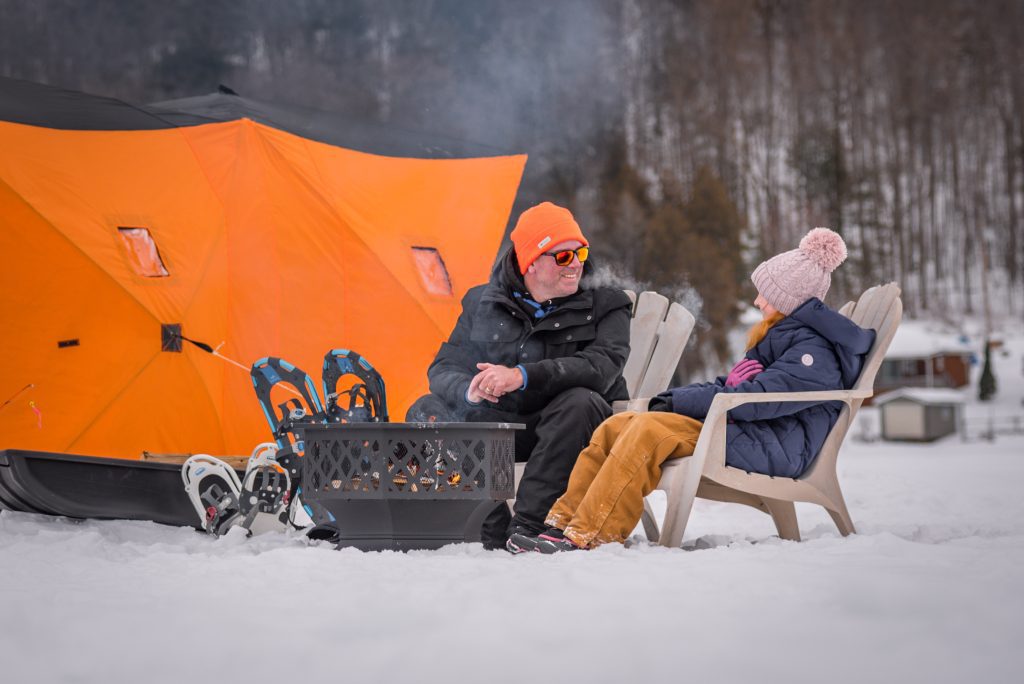
“It’s a great way to get outdoors during the winter, especially when people kind of start hibernating and get indoors. And it really builds lifelong memories and skills. It keeps people off their devices, engaging in different ways of experiential learning, and provides healthy food for people that want to catch and keep their fish.
“What do they say? A bad day fishing is a better than a good day in the office.”
Visit the OFAH website for more info, or follow them on Instagram and Facebook


